

A view of a pair of benchmark Tuscan wines, both fully mature and both bordering on perfection! Both were bought on release and stored in my cellar since release. This was a very impressive way to close out January 2025!
2007 Pian dell’Orino, Brunello di Montalcino (RT98) At age 17, the 2007 Pian dell’Orino is in prime drink form and expressing itself magnificently! Pale garnet with a parchment paper hue, the spicey bouquet takes centerstage as its red fruit core delivers perfectly balanced notes of red cherry liqueur, umami tinged dried red currants, Tuscan scruff, crushed stones, savory herbs and a handsome backbone of minerality. This is utterly superb, every dimension is in perfect harmony on the palate as it displays a near weightless elixir of dried fruit, perfect food-friendly acidity and a long, long caressing and refined finish. A masterpiece of vineyard management, superb terroir and world class winemaking! It should be no surprise this relatively new winery is across the lane from the legendary Biondi Santi. Drink now-2037 Tasted January 2025
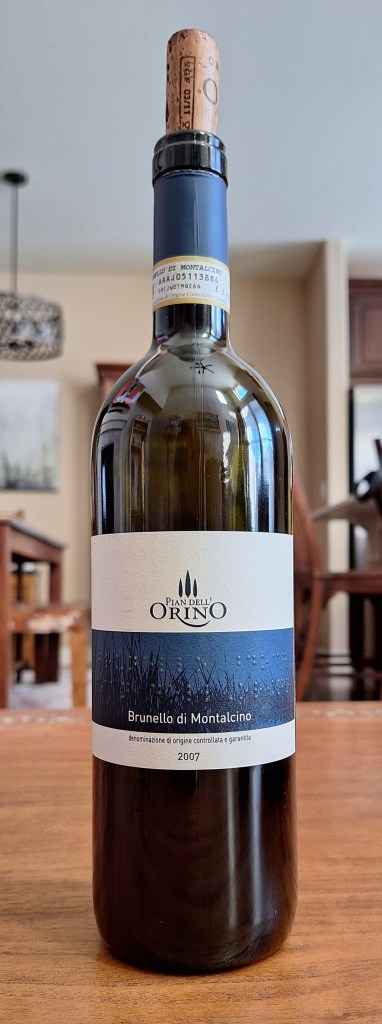
Pian dell’Orino is a new winery positioned in a place of enormous history. Founded in 1997 by owners Caroline Pobitzer and Jan Erbach, they purchased the first property, which is across the lane and adjacent to the legendary Brunello producer Biondi Santi. Little did they know the prime real estate it would evolve into. It has been a whirlwind of activity since, and they have also acquired additional vineyards adjacent to their winery, as well as some in Castelnuovo dell ‘Abate in the southeastern zone of Montalcino. In their quest to produce the highest level of Brunello they possibly can, they have embraced both organic and biodynamic vineyard management. Consequently, the estate’s six hectares of vines have been farmed completely organically for many years and since 2003 have been cultivated under biodynamic principles. In 2004 they began the micro-zonation of their various vineyards. Their first was Brunello Bassolino di Sopra – a single vineyard bottling- was labeled as a Riserva. They then refined and made the division between Brunello Vigneti del Versante and Bassolino di Sopra, two smaller single vineyard plots. Today their winery is certified biodynamic, one of the first in Montalcino to achieve such accreditation. Their quest for imparting a gentle carbon footprint and a wholesome vineyard ecosystem is balanced with the mission for producing superior quality in the finished wines as they undertake every miniscule detail of the process with the utmost precision. No amount of minutia is too small. The results are breathtaking!
Grapes for this wine are gently hand harvested and once in the cellar are treated as lovingly and as naturally as possible. They employ only natural winemaking methods, utilizing exclusively non-inoculated, native yeasts, and use no extraction enzymes or added grape must. Their wines ferment completely and are then aged in large 10-50 HL botti for one to five years prior to bottling, depending on the wine. They currently produce a total of approximately 17,000 bottles annually. While their wines have risen in price in the past decade (which winery hasn’t?), they remain one of my favorite Brunello di Montalcino producers and are more than worth their asking price. Another example of one of my foundational wine-buying axioms: Producer over Vintage! Always!
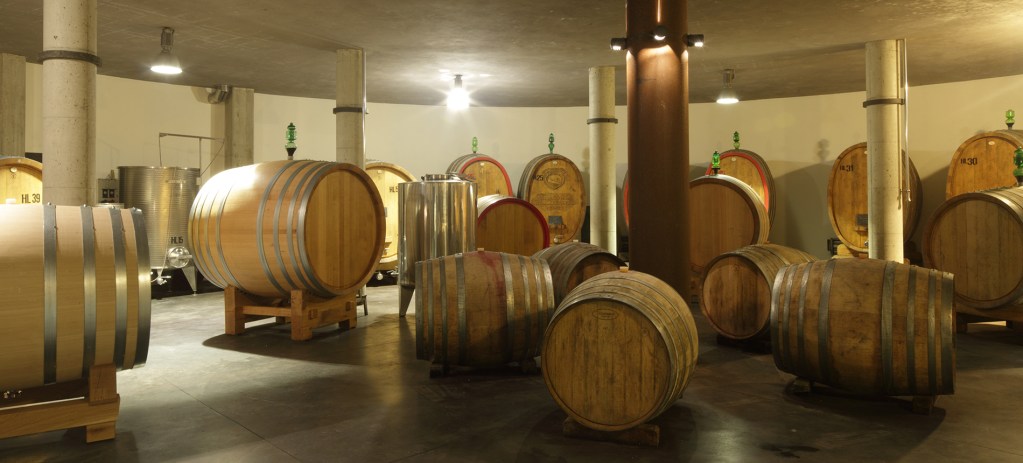
2000 Castello dei Rampolla, Toscana IGT, d’Alceo (RT98) At age 24 the 2000 d’Aleo has evolved in an amazing direction and has brought forth all the grandeur I expect from this benchmark wine. A blend of 85% Cabernet Sauvignon with 15% Petite Verdot. Deeply pigmented, strutting an almost impenetrable deep fuchsia hue with a light cast of garnet, notes of black currant, kirsch, exotic spices, black rose, underbrush and a pinch of cigar box emerge from the stem. This gem remains focused on the display of its gorgeous ripe fruit with a mineral punctuation mark. The bouquet is super charged and powerful, leading to a seamless palate built of its dark ripe fruit, alluring acidity, and tannins that caress the mouth with their ripe succulence. Beautiful and superbly balanced, this is a work of winemaking art! Drink now-2040 Tasted January 2025.

This historic estate, founded in 1956 and owned by the Di Napoli family since 1964, is situated in Panzano’s grand sunbaked, south-facing amphitheater known as the Conca d’Oro. Selling its first estate bottles in 1975, Castello dei Rampolla emerged as one of a hand-full of producers who played a major role in the revival of Chianti Classico. It was under the stewardship of Alceo di Napoli Rampolla that Castello dei Rampolla began to make a name for itself. Inspired by the likes of Mario Incisa della Rocchetta (creator of the very first Super Tuscan named Sassicaia), Alceo decided to attempt his own Bordeaux style wine using Cabernet Sauvignon. He recruited the help of world famous consultant oenologist Giacomo Tachis and soon enough Castello dei Rampolla’s ability to incarnate Bordeaux blends in Tuscany pushed the estate into the spotlight. Alceo passed away in 1991 and the estate was passed to his children: Luca and Maurzia di Napoli. The siblings have continued their father’s revolutionary work, transforming the estate with biodynamic farming practices, removal of chemical treatments in the vines, as well as manual harvests. Alceo’s children have also dedicated a wine in his honor: d’Aleco. The winery also produces a legendary bottling called Sammarco, which is a blend of Cabernet, Merlot and a splash of Sangiovese, along with a tiny production 100% Merlot called Liù, a Chianti Classico and 3 other wines, 2 of which are white varieties. This is a winery to keep an eye on, their wines are nothing short of spectacular!
D’Alceo is a single vineyard bottling harvested from a 6 hectare plot and was first introduced in the 1996 vintage. It is a blend of 85% Cabernet Sauvignon and 15% Petit Verdot fermented in concrete vats, followed by maceration on skins for 30 days in untoasted and medium toast barriques and 500L tonneaux, of which 10-15% are new barrels. It is then aged for 14-16 months and bottled, with a resting period of 24 months prior to release. Average production is 6,000-12,000 bottles per vintage, depending on climatic seasonal conditions.
