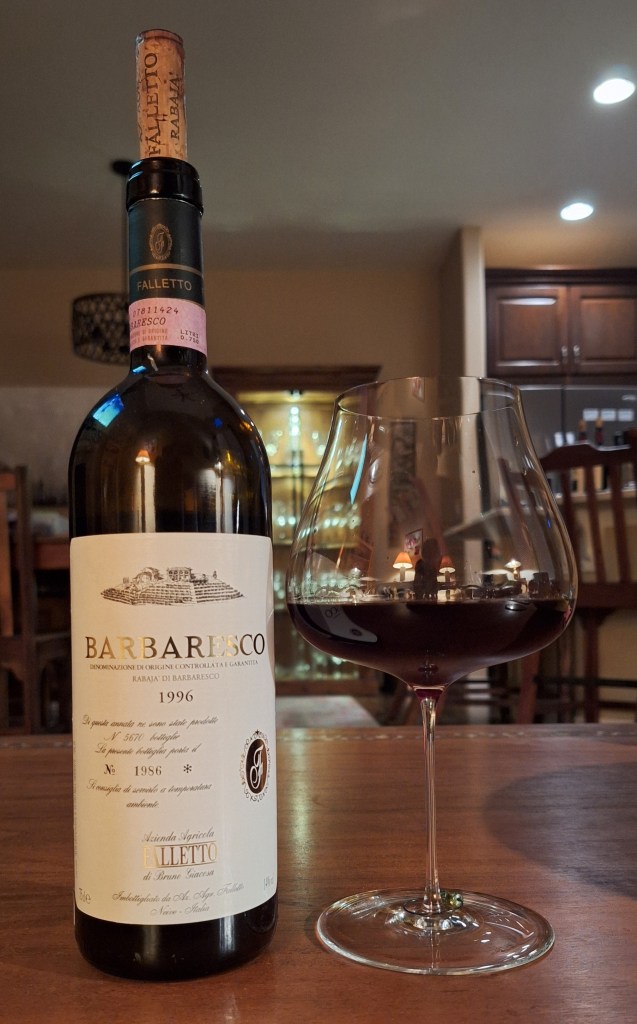
1996 Giacosa, Barbaresco, Rabajà (RT97) At the age of 28, the gorgeous, tertiarily nuanced 1996 Rabajà wafts up a complex, classically austere bouquet of mentholated Marasca cherry liqueur, spiced Damson plum, soaring balsam, dried violets and rose petals, and limestone dust. With time in the glass more nuances emerge, creating a magical elixir of ever-morphing aromas built on that classic Giacosa Christmas spice, a nuance that in my view defines his classic Nebbiolos at maturity. The palate is sooooo 1996, balancing perfectly dosed fruit with just the right amount of acidity and finishing with firm tannins that have slowly begun to fade and soften a bit. This is an awesome showing, but there may be an upside to continued cellaring for those who yearn for even more evolved fruit and softer tannin. I love it either way. Drink now-2040+ Tasted December 2024
The legendary producer of both Barolo and Barbaresco, Bruno Giacosa, who passed away in 2018, built an unparalleled vinous dynasty over his time and left a heavy load for his daughter Bruna to now follow. With the assistance of his former head enologist, Dante Scaglione, together they are surpassing the challenge and carrying on Bruno’s lofty reputation with style and grace. In 2006 Bruno suffered a devastating stroke that left him a shell of his former self. But the proof is in the pudding, and Dante, along with the assistance of Bruna, have carried on in a style fitting of one of Piedmonte’s true legends, and supported by many of the impressive wines that have been bottled since, especially his amazing Riservas, which in my experience rank among the greatest Italian reds every produced.
The history of Giacosa’s original Rabajà bottling is both intriguing and controversial, with his first vintage being bottled in the above reviewed wine: 1996. That year Giacosa acquired two parcels from Odore, who was a member of the Produttori del Barbaresco collective. One of the parcels is a long narrow vineyard plot oriented to the west and augments Giacosa’s original Asili parcel, while the second parcel was entirely separate, oriented toward the south, and is surrounded on three sides by other Asili Cru plots. Only on its eastern narrow end does it share a narrow boundary with the Rabajà Cru. Yet for some unexplained reason, no one that I’ve ever talked to, or who has written about it, has ever been able to determine WHY Giacosa decided to call this parcel Rabajà and bottle it as such. Yet that is exactly what he did. From 1996 through 2005 this parcel was bottled as Rabajà. These vintages were bottled as classico white labels, except for 2001, when it was bottled as a Riserva, a wine that has become a bit of a legend. I’ve had the 2001 Riserva numerous times, and it is truly extraordinary. But then again, one can say the same for the 1996, and the 2004 bottling holds even greater promise than the 1996, perhaps the finest on the heels of the 2001 Riserva. Even 2005 is exceptional, but the other vintages are not far behind.
In 2007 Barbaresco production regulations were amended to include the MGA, Menzione Geografica Aggiuntiva (or MeGA), a specific vineyard area that is similar to the French cru or climat. This ended Giacosa’s bottling of this parcel as Rabajà and coming forward he bottled this plot as Asili, which by all rights it always should have been. Now grapes from this parcel are either blended into the Asili bottling, or at times are blended into Giacosa’s classico Barbaresco (white label) or in vintage when he has bottled the western-oriented parcels as Riserva, he has bottled this parcel as a white label Asili. I’ve also been told that in some vintages the grapes are sold off to the bulk wine market but have not been able to verify that.
As a sidenote, and to add final clarity, in 2013 Giacosa purchased a plot that is within the MGA delimited Rabajà Cru and has since begun bottling it as such, thus adding another layer of confusion to the saga of Rabajà.
This wine was hand harvested from the plot outlined above, gently pressed and slowly macerated and followed by a two-to-three-week fermentation in stainless steel at moderate temperatures. The wine was then aged for 36 months in untoasted French oak botti, which Giacosa has utilized for decades. Even with the inner secrets of his winemaking techniques exposed, there is something unexplained and magical about his wine that only Bruno, Bruna and Dante likely know. Behold the mystique of Bruno Giacosa’s wines!
Sincere credit to Ken Vastola, a longtime friend and mega-Giacosa fan, and his Fine Wine Geek website where he thoroughly documents the history of Giacosa’s wines and details the pair of Rabaja Cru acquisitions. You can find it at www.FineWineGeek.com